
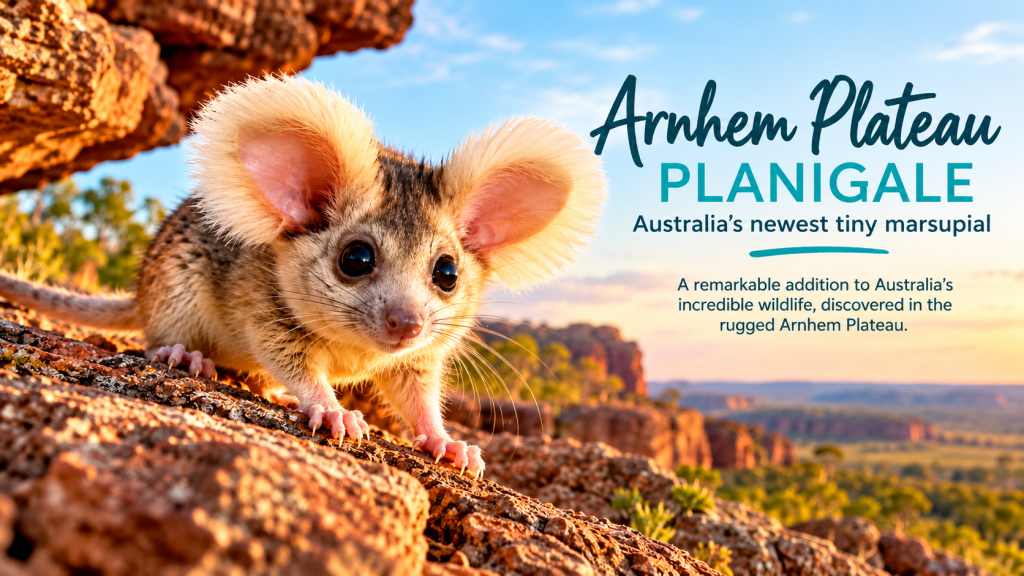
Artistically recreated representation of the Arnhem Plateau planigale.
Arnhem Plateau Planigale
A tiny marsupial with a very big scientific story
Australia has gained another species of tiny marsupial — the Arnhem Plateau planigale (Planigale petrophila), formally described by scientists in 2026.
Planigales are among the smallest marsupials in the world. Despite their mouse-like appearance, they aren’t rodents at all. They belong to the dasyurid family, the same broader group of carnivorous marsupials that includes quolls and Tasmanian devils.
The Arnhem Plateau planigale is found in the rugged Arnhem Land region of Australia’s Northern Territory, particularly the sandstone escarpments and rocky plateau habitats around Kakadu National Park.
Its scientific name, petrophila, roughly translates as “rock-loving” — a fitting name for a species that appears to have adapted to life among rocky slopes, sandstone platforms and narrow crevices.
Tiny predator, remarkable adaptations
Planigales may be tiny, but they’re active predators. They feed on insects, spiders and other small animals, using their narrow heads and remarkably flattened skulls to squeeze into tiny gaps beneath rocks and in crevices.
The Arnhem Plateau planigale is unusual among planigales because of its apparent preference for rocky plateau habitats. It is somewhat larger than some of its relatives and has a particularly long tail.
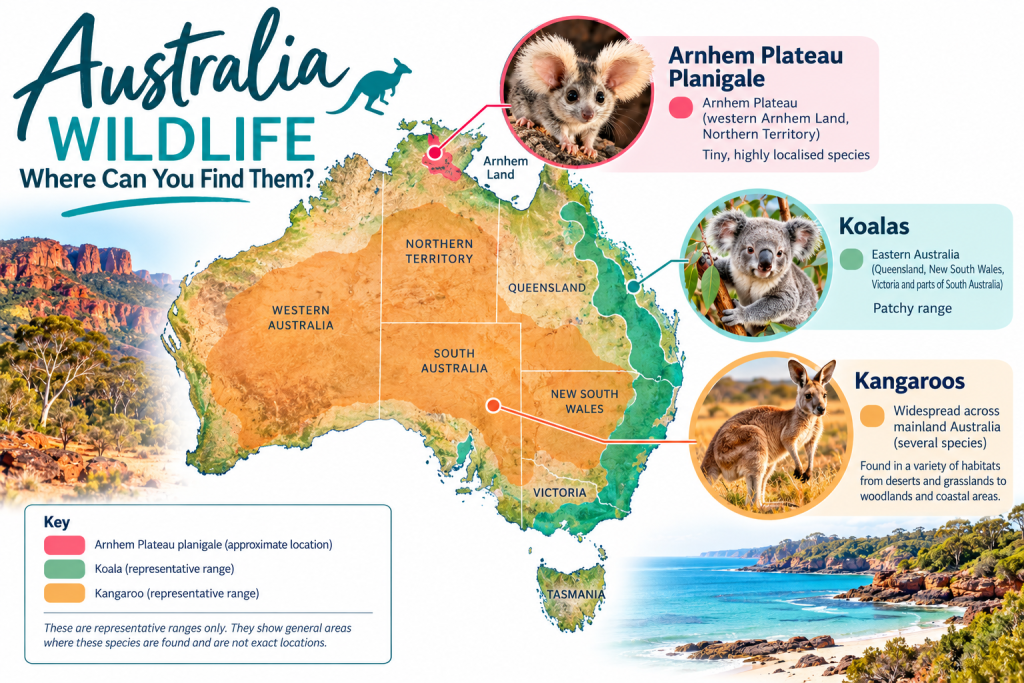
A species hiding in plain sight
What’s especially fascinating is that scientists didn’t simply stumble across a completely unknown animal in the Australian wilderness.
The animals had previously been classified as part of another planigale species. Researchers examined museum specimens using genetic analysis alongside detailed anatomical comparisons and discovered that this population was sufficiently different to represent a species in its own right. (DOI)
The research also revealed that what had previously been considered one widespread species actually contained several distinct evolutionary lineages.
Why this discovery matters
The Arnhem Plateau planigale is currently known from only three specimens, all from a relatively small area of western Arnhem Land. Researchers have not encountered the species since 2004, making its true population size and current distribution uncertain. (DOI)
That makes its discovery particularly important from a conservation perspective. Recognising a distinct species means scientists can assess its conservation needs separately from its more widespread relatives.
The Arnhem Plateau is already recognised as an area of exceptional biodiversity and endemism, and discoveries such as this show that there is still much to learn about Australia’s wildlife — even among animals that scientists have been studying for decades.
Wildlife doesn’t always have to be big, dramatic or easy to spot. Sometimes the most fascinating discoveries are hiding in a crack in the rocks.